A ten-week run club. A 5K finish line. A community that stays.
Belong In Movement is deliberately simple. No facility to build, no equipment to buy, no talent to qualify for. Just a group of children, a route, and a small number of trusted adults who show up twice a week. Everything else grows from there.
The Run Club
The pilot is a ten-week run club for children, meeting twice weekly after school and building toward a group 5K. The finish line has no clock and no rankings. Everyone crosses it together.
We chose running for a reason. It has the lowest barrier of any sport — no membership, no gear, no gym. A child can keep doing it long after the programme ends, alone or with friends. And it teaches the exact lesson the programme exists to pass on: you start out of breath, you're not good at it, and then slowly, almost without noticing, you're at the finish line. Progress you can feel is the whole point.
The Ecosystem
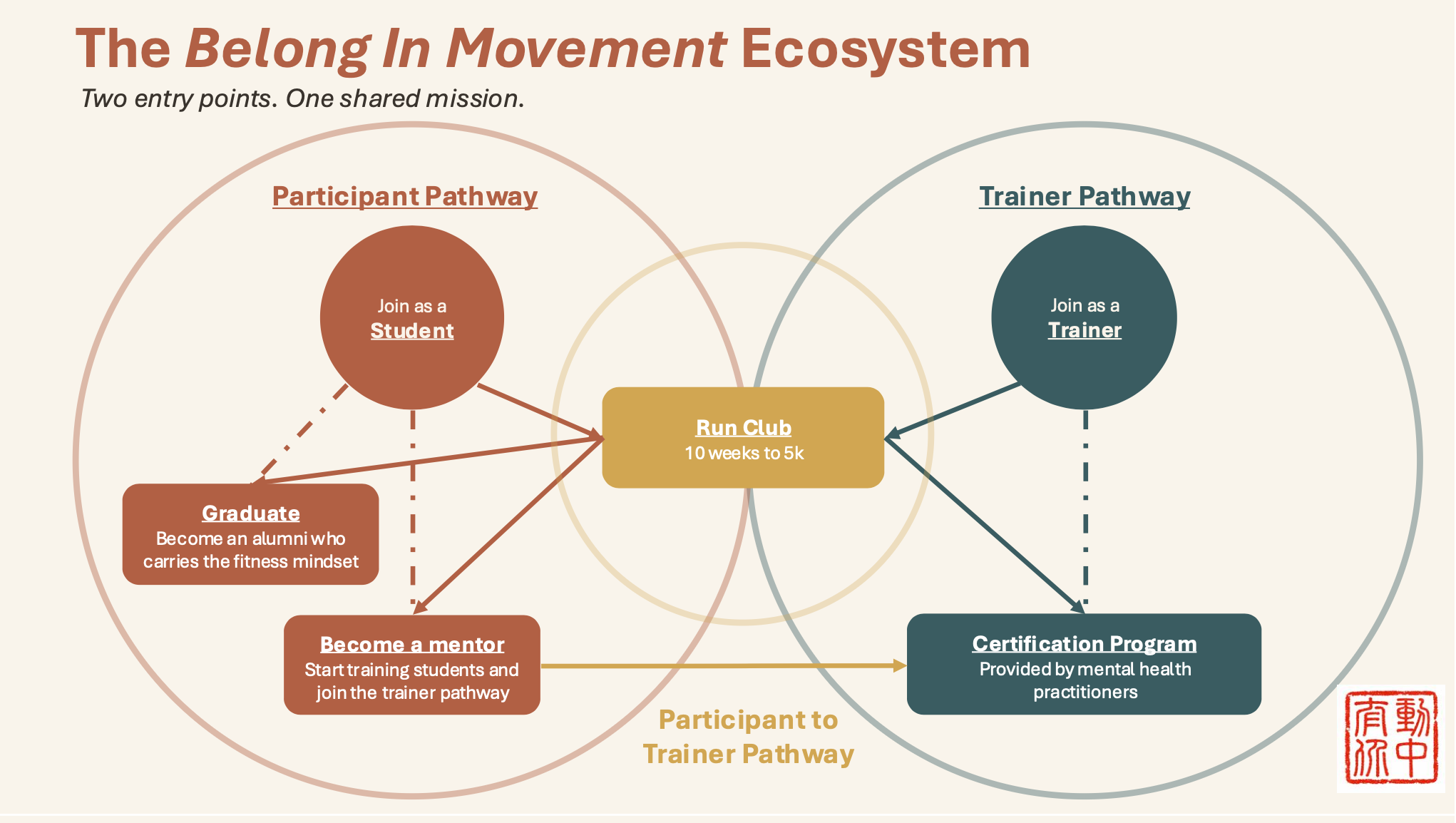
Belong In Movement has two entry points.
Children join to run. They arrive as participants, complete the ten weeks, and cross the 5K together. Those who want to stay can grow into peer mentors, and eventually toward trainer certification themselves.
Fitness professionals join to lead and to learn. Many of Hong Kong's most capable coaches come from the very communities the programme serves and are underused as mentors. They lead the runners and, through the capacity-building training, gain accreditation and a deeper sense of purpose in their work.
Over time, the two paths converge. The community Belong In Movement serves becomes the community that leads it.
The adults in the room
A run club is led by fitness professionals — but at Belong In Movement, leading is only half the role.
Trainers are trained to notice: to recognise early signs of distress, withdrawal, or trauma in the children they run alongside, and to connect them with the right support.
The principle is simple. The adults already present in a child's routine — the ones who see them twice a week, who notice when they go quiet, who earn trust through regularity rather than authority — are better placed to spot when something is wrong than any specialist a child is unlikely ever to reach. Trainers are equipped to notice and refer, never to diagnose or treat. Support pathways are established before the first session.
How it scales
The model is built to travel.
By district. Each new site needs only one instructor, one route, and one network of local guardians. No facility, no equipment, no proprietary technology.
By capability. The trainer training — trauma awareness, early detection, referral pathways — can be delivered to fitness professionals in any city.
By generation. Graduates who become mentors and trainers are the infrastructure for the next cohort. The programme scales from the inside, not the top.